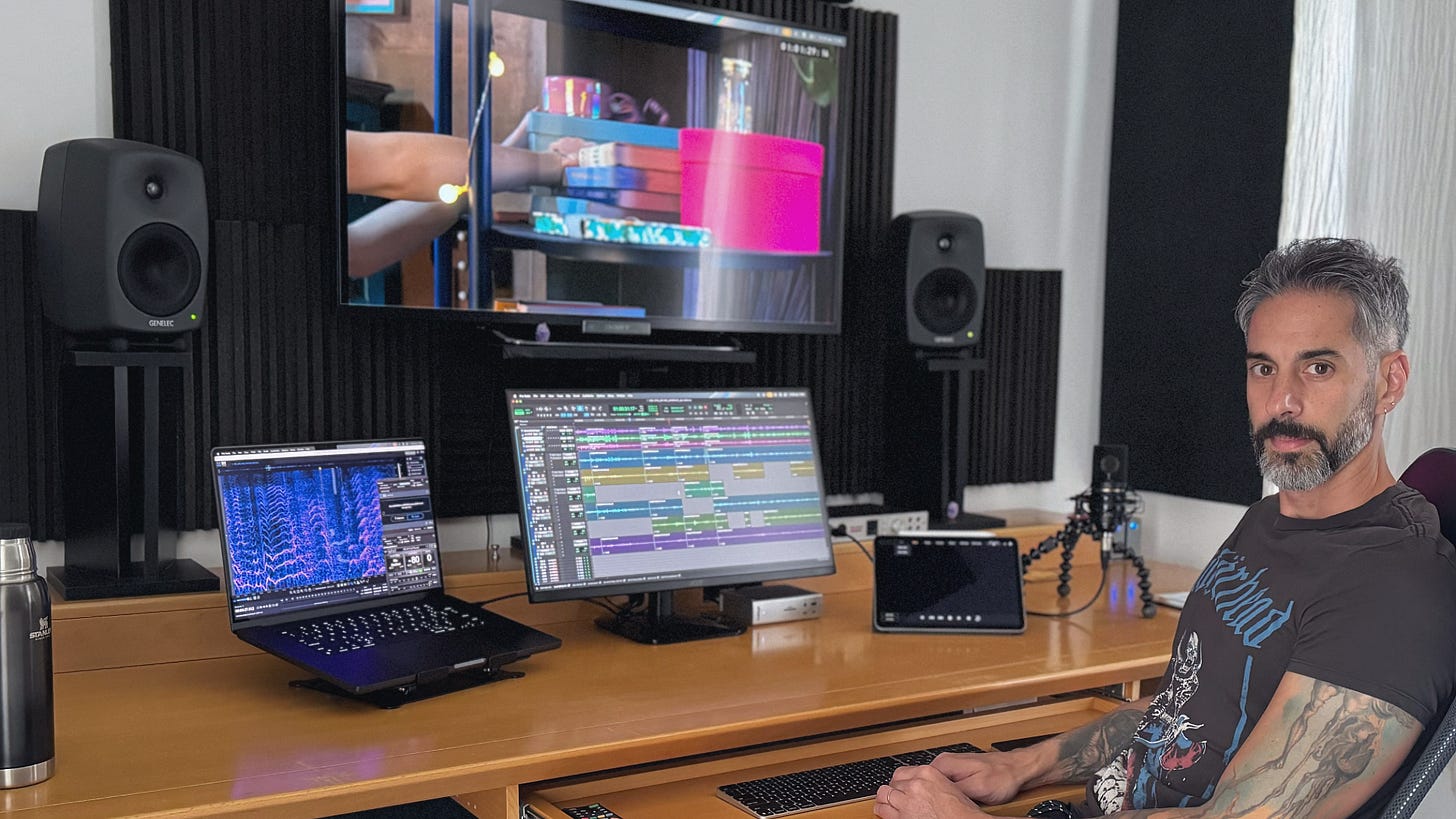
In Conversation: Matias Caldarella, MPSE.
Thanks for reading Audio Pro Network! Subscribe for free to receive new posts and support my work. Joe Miuccio Matías, it’s great to finally sit down and document your story. Your work spans sound design, dialogue editing, and re-recording mixing, and your career reflects a thoughtful, intentional approach to audio post production. I’d like to start by going back to the beginning. What first drew you toward sound as a profession? It’s a pleasure to talk with you, Joe. I would like to thank you, because you’ve been so kind to me sharing your experience and knowledge from day one, and for all the hard work you put into the Audio Pro Network platform, how you connect people, your podcast, and The Audio Post Accelerator Mentorship. Your commitment to helping the sound community is an example to follow. Going back to the question, the earliest memory I can recall is when I was likely 5 years old, and my father was listening to the song “Born to Be Alive” by Patrick Hernandez playing on a KenBrown X700. My body was at speaker height, and I felt very drawn toward the sound of his voice, its special character, suddenly that roar cutting through the song, like thunder with perfect bass and a rugged sound. I was speechless. I couldn’t understand what was happening, but I felt completely absorbed by the sensation in my body and ears. Since then, I used to listen to that record over and over. My father graduated from the conservatory as a classical guitar player, and soon I found myself trying to stick my fingers on the guitar neck to play an F major chord. Of course I couldn’t. Many years later, I got my first “sound post gig” on a very small video production for kids. I had to “mix” the music with voices and cut mistakes using Cool Edit on Windows 95. Career origin and early pathJoe Miuccio Thanks so much for your kind words, I really appreciate it! I love your story, but I actually had to look up what a Ken Brown x700 was! So these moments at home were the spark, but when did you first realize that audio post sound would be your professional path, and what initially pulled you toward audio post production specifically? Matias I was always driven toward music and sound. I started DJing parties and playing electric guitar I loved the physical sensation of a speaker pushing air and the ability to shape tone using effects. I also deeply admired the sound of TV series; I often recalled audio more vividly than visuals. Shows like Robotech and Mazinger Z left a mark on me, I can still hear the weight of Mazinger’s footsteps and the mechanical seal of Rick Hunter’s cockpit. Those sonic signatures are imprinted in my brain. The defining moment was watching a mixing session in a studio using Nuendo. Wires and faders were everywhere, meters were peaking across tracks, yet through that chaos, disparate parts became a cohesive song. I realized I wanted that sensibility, the ability to engineer an experience for an audience. I began wondering how to achieve that level of craft in the TV shows I loved. I realized then that the world of sound was vast, and I was determined to find my place in that ocean. Joe Miuccio Great that you mention Nuendo, really one of the great DAW’s. So let me ask, what were you doing before audio became a serious career pursuit, and how did that transition actually happen in real terms? Matias I started working at an early age to support myself. I had a natural aptitude for computers, and a teacher introduced me to a local computer store, which became my first ‘real job.’ It was a humble start with modest pay, but it taught me the technical discipline I use today. My transition to audio began with that freelance ‘sound post gig’ for a small production, where I cut off-camera dialogue and mixed it with music. That experience allowed me to leave the computer store and join a small dubbing studio as a recording technician. I quickly advanced to recording voice artists myself and then mixing episodes. I clearly remember working on the Little Amadeus series. From there, I secured a position at a major studio where I worked as a re-recording mixer for the Discovery Network and various Argentinian TV shows. Joe Was there a specific project, moment, or challenge early on that made you feel like this could be a long term profession rather than just a passing interest? Matias Absolutely. During film school, I took courses in psychoacoustics, sound design, Foley, and audio electronics. I became fascinated by how we can use sound as an object or an index to create specific feelings. I loved the concept of sound montage, using a combination of sounds like an orchestra to elevate the visuals, positioning them in space to make a scene feel real, or often, “better than reality.” I started critically listening to movies to learn how to combine those elements, and I became completely immersed in that world. The possibilities seemed limitless. But what solidified it as a career path was the collaboration. We have to understand others’ ideas, respect their intentions, and do our best to improve the experience. The fact that no two projects are ever the same is what drew me deep into the world of sound; it means I never get bored. Joe As you know, I mentor young people from around the world who are just beginning their careers. With that in mind, I’d love to ask you this. In the early stages of your career, which skills challenged you the most, and how did you go about closing those gaps? Matias I am still learning, luckily. I have many things to overcome, but I will focus on one major challenge. I still find myself fighting with the idea of perfection, a concept that exists only in my mind. I obsess over details: how accurate a compressor is, if 0.2 ms could be tweaked to attack a transient better, or how to make EQ curves more precise. I think about the latency produced by distance and the propagation speed between light and sound waves. All of that matters, but only until those parameters disrupt creativity and feeling. When the filter becomes more important than the notion of the space itself, or when technical specs make me forget the message, I know I have gone too far. I once heard a musician say: ‘I play in favor of the song. I am at the service of the song, not playing to show my technical skills.’ That concept stuck with me, and that is what I try to focus on. Finding work and building momentumJoe How did you land your first real professional audio post work, not student projects or experiments, but paid work with expectations attached to it? Matias My first real job was actually quite relaxed. Deadlines were loose, which gave me plenty of time. As a newcomer, I could even take double the time on each Little Amadeus episode to get it right. When I started working for Discovery Networks, the pace changed completely. Deadlines were tight, and turnarounds for notes were fast. I had to manage my schedule perfectly or fix issues on the fly to avoid revisions. This was my first truly demanding job. I was fortunate to learn from experienced professionals during that time. Coming from film school, I was focused on quality and design, but in the real world, especially in dubbing in my country, timelines are incredibly tight. I learned to work fast, then faster, and then even faster. I learned to make quick decisions and understand exactly what the production needed. That experience was at Video Dub S.R.L. Despite the challenges that company faced, it was a great place to train, and I still remember everyone there with respect. Joe What types of projects helped you grow the fastest early in your career, and why do you think those experiences mattered? Matias After my first job, I moved to CIVISA, the largest dubbing studio in Argentina. The supervising sound editor at the time was Maximiliano Wynen, who is now the VP of Global Operations at The Kitchen. He was an outstanding professional who knew how to manage people, time, and business. I learned a massive amount from him, not just how to work faster, but how to direct voice artists and train producers. He taught me to work smarter and stay focused on the ultimate goal. I realized that technical knowledge can be acquired by reading a manual -something I do constantly and recommend to everyone- but human knowledge must be acquired by watching others and communicating clearly. Learning to handle criticism and own my mistakes during my time at CIVISA was the most important lesson I could have learned. Joe Looking back, what do you think actually helped you move forward professionally: talent, persistence, relationships, timing, or something else? Matias I think a combination of relationships and persistence is the baseline. While persistence alone brought me knowledge and experience, relationships were what sealed the deal. Having good relationships helped me grow exponentially by learning from others. Because I expanded my network, I was able to find more opportunities, not just for work, but for connecting with new professionals and mentors. Joe This is amazing advice Matias. Were there periods where work slowed down or felt uncertain, and how did you stay engaged with the industry during those times? Matias Yes, there have been, and there surely will be more. When a slow period happens, I focus on improving skills, upgrading workflows, and finding new ways to express myself. I analyze movies to find details in sound design, dialogue editing, and mixing that I might have missed, or to identify a weakness in my own knowledge that I can strengthen. Whether I am working on sound design or mixing, being aware of the details in each discipline helps me be more precise and a better team player. This process feels like unlocking a door. My goal is to understand, not just copy. I ask myself: Why did they make that choice? How can I apply that logic while adding my own taste? Asking questions is one of my best tools; the ‘five questions rule’ almost never fails me. I also focus on a concept I call ‘Overcoming Eons.’ I see ‘eons’ as distinct eras of drastic change within a single career, not human history. Today, the focus is on AI. I strive not only to understand and adapt to it but to incorporate it as a tool to improve efficiency and spark new ideas. I also use this time to fine-tune personal nuances and review past projects to ensure I learn from every experience. Mentorship and influenceJoe Who were the most influential mentors or senior professionals in your development, whether formally or informally? Matias This is a great question. I have been fortunate to meet many great professionals. My philosophy is to learn something from everyone; I believe anyone can offer a valuable perspective if we listen carefully. In my early days, Pablo Campañó, one of the owners of Estudio Mandinga in Argentina, was a crucial supporter. He is versatile and always searching for new horizons. Even during slow periods, he was constantly improving workflows or testing new ideas. As for formal mentors, I was lucky to meet Joe Schiff. He was incredibly kind and respectful, offering advice on my dialogue and sound editing work. With two Emmys and a vast filmography, he is a detail-oriented professional who knows exactly how to deliver what is expected. I learned a great deal watching him work. I have also received great advice from you, Joe. By welcoming me into your mentorship network, you bridge geographic gaps and provide connections without borders. I know people who have taken your program and were thrilled with their improvement. I also must mention James Redding III, whom I met through Audio Pro Network. He is incredibly talented. His ability to combine workflows with state-of-the-art creativity is inspiring. He is one of those rare cases where speed truly meets quality. Joe What did those mentors teach you that went beyond technical skills? Matias I cannot list every lesson, but I will highlight three: organization, the re-purposing of tools, and networking. Organization involves knowing how to start a project, manage turnarounds, structure the editing process, and understand exactly what to deliver. It also taught me the value of patience. As for re-purposing tools: a developer may design a tool with one specific objective in mind. However, by understanding the internal components, routing, and available modules, I learned I could use those same tools to accomplish entirely different tasks. Finally, networking. I learned the incredible value that genuine connections add to your career and goals. Looking back, I know I would not be where I am today without the people I have met. Joe Were there moments when someone opened a door for you or trusted you before you fully felt ready? How did that affect your confidence and trajectory? Matias That happens almost every time, and I’m looking forward to it forever, because it means I’m improving, but I make a strong distinction regarding my attitude. Working year after year has reinforced a sense of absolute objectivity rather than forced positivity. Everyone has limits, but few accept them. By accepting my limits, I can be honest with others about what I can and cannot do. I recall Jordan Peterson talking about his early career. He said that at a certain point, he accepted who he was and decided to show it openly: ‘This is who I am, no more, but certainly no less.’ I took that as a complete truth. By knowing and showing exactly who we are, we invite trust. Everyone makes mistakes, but failure is designed to teach us. We just need to face it the right way. Joe How do you think mentorship shapes careers in audio post differently than in other creative fields? Matias In my experience, it is very hard to break into the industry alone. Without mentorship, good networking, and good attitude, you might get stuck in a loop of similar challenging projects. By learning from more experienced people, looking at what they are doing, and going forward, you open up possibilities. Nobody makes it without others, and as Angelo Palazzo wrote some time ago, this industry moves by contacts, and I certainly agree. The worst case scenario is finding yourself alone, I’ve been there many times, searching for something to do. My idea is to know what I want to do and reverse engineer that idea. Who is doing it? How are they doing it? What should I change in my life, as a professional and as a teammate? And then reach out to the right person or people. Mentorship closes the gap between who we want to reach out to and us. Sometimes we don’t know the right people, sometimes they don’t have time to read our spare LinkedIn message, and sometimes they don’t even want to get in touch with us. But mentoring is the bridge closing the gap. It is our road to our goals. Relationship to Audio Pro Network and mentorshipJoe I talk to a lot of people and we’ve known each other for a while now, so Im sorry if my memory is lacking here, but remind me. How did you first connect with me and Audio Pro Network, and what stood out to you about the community compared to other industry spaces? Matias I found Audio Pro Network on LinkedIn. I reached out to you, and we had a great video call where you shared insights and advice, and we got to know each other. What stands out about APN is the personal touch. You take care of everyone there; you are available and act as the heart and soul that keeps the community connected. The design of the network is simple, allowing for a frictionless experience. As expected, the members are incredibly willing to help. Everyone invests time in building the community, giving access to both professionals and peers who are looking for the same growth. You are also very proactive in securing deals and sharing articles that help our careers and open our minds to new ideas. Joe Thanks for all the kind words Matias, I try to do my best! Let me ask, in exactly what ways did your mentorship conversations help clarify your direction or decision making as your career progressed? Matias The most important aspect of these conversations is the need to revise my own thinking and strategy. Growth begins through the process of explaining, sharing, and rethinking. With so much information shared by many participants, ideas flow freely, and our own subjectivity acts as a filter. We pick up concepts, iterate on them to create something new, and then share them again to restart the cycle. Joe What do you think younger or emerging audio professionals often misunderstand about building a sustainable career in post production? Matias As many of us did initially, emerging professionals often shift their focus from the craft itself to technicalities, money, or distractions unrelated to the ‘flow’ of the work. True sustainability comes from the pleasure of working for the sake of the craft. This mindset fosters creativity and helps us develop a unique style. Repeating this cycle creates momentum, which drives improvement in speed, precision, and creativity, the three hallmarks of a professional. Today, we are bombarded with new tools. While attractive, we rarely need all of them. Obsessing over these tools often shifts the focus from creativity to technicality, distracting us from what actually matters. Joe How do you personally try to “pay forward” the guidance you have received from mentors? Matias This is an interesting point, because while we feel a need for reciprocity, many mentors seek nothing more than the pleasure of helping. From my perspective, the best way to show gratitude is to become as proficient as possible. I aim to use the knowledge they shared in every possible way, showing up to work as if I am honoring them with every project. And, of course, I make sure to support them whenever I can and ensure that everyone knows who helped me along the way. Professional focus and recognitionJoe You work across sound design, dialogue editing, and re-recording mixing. How do those disciplines inform one another in your workflow? Matias Even when I am focused on one discipline per project, they interact all the time. If I am working on sound design, I maintain a full overview. I need to understand the director’s vision, what the supervising sound editor expects, and what the dialogue editor is providing. Being a mindful team member is crucial. I tailor my design to facilitate the re-recording mixer’s work, prioritizing the project’s needs over showing off my individual skill set. I consider where the music will sit and how instrumentation works to ensure my design fits the project. This connection also relies on tools. I ask: Which tool from one discipline could help another? A subtractive synthesizer can round out a thin sound effect or add brightness. An overdrive plugin can help a car engine roar or add grit to a scream. Multidisciplinary work is incredibly beneficial when we are open to breaking barriers. As a re-recording mixer, I believe I must understand every other discipline deeply perhaps more than they need to understand mine. This allows me to give clear guidelines and make wise decisions without interrupting the production timeline. Joe What kinds of projects do you feel best represent your strengths as a sound professional right now? Matias In recent years, I have focused heavily on film work as a sound and dialogue editor. As a sound editor, I thrive on creativity. My goal is to find ways to communicate the narrative and help the story speak more clearly. As a dialogue editor, I focus on making that communication flawless, clear, and transparent. Actors tailor their performances on set, studying and rehearsing to match their body performance and emotions. I find it both challenging and rewarding to respect that effort and preserve their original performance, minimizing the need for them to re-record. When I mix, I view it as an opportunity to make the entire team’s work shine. I have the privilege of using the work of sound designers, dialogue editors, editors, and actors to build the world the director envisioned. Joe How did your involvement with MPSE Wavelength Magazine come about, and what does contributing to the Tech Corner mean to you professionally? Matias It actually started with a funny misunderstanding. I have been using Krotos software for a long time, and while reading Wavelength Magazine, I saw an advertisement for them. I thought it would be valuable to have a review of the software they were advertising. Since Christina Horgan was one of my MPSE sponsors, I reached out to ask why there wasn’t an article showing Krotos Studio in use. She thought I was complaining about the lack of content, so she challenged me: ‘Why aren’t you writing it?’ So, I became a contributor to the Tech Corner. Later, I had the pleasure of sharing lunch with Christina and Tracy Costabile, where we laughed about how that small confusion blossomed into a beautiful collaboration. Professionally, it means a great deal. Being an active member of the MPSE is a significant milestone for me. It is a responsibility I honor by striving for excellence in every project. Contributing to the magazine allows me to grow as a professional while sharing insights that hopefully inspire others to refine their own craft. Joe How do you stay technically current while still prioritizing storytelling and emotional impact in your work? Matias As we discussed, I view technical currency and storytelling as part of the same mindset. Adaptation is essential for any professional. When I started with sound design, I used Propellerhead Reason 7 to build sounds. My racks had a dozen devices and even more patch cords at the back, connecting CVs, routing LFOs to AMPs, and ADSRs to filters, all while using a rustic timeline to automate parameters just to create one specific effect or sound. Today, tools like Krotos Studio Pro cut through that clutter. While the workflow is different, it allows us to create using our own sounds in a fraction of the time and in a visual way. The same applies to tools like Igniter, Sound Particles, and Reformer among others. Staying current allows me to expand my capabilities. Being aware of what is new helps me discern when I need a complex modern tool, and when I am better off using my trusty hammer and nails. Looking forwardJoe What kinds of projects or collaborations are you most interested in pursuing next, particularly in the United States? Matias I am dedicated to continuing my path in sound design, dialogue editing, and re-recording mixing. I feel the time has come to advance my career and further fuel my curiosity. In this fast-paced, changing era, staying current, adapting, and growing is a must. To fully honor my passion and continue this growth, I am looking forward to taking the significant step of bringing my experience to the U.S. industry. Joe How do you see your role evolving in the industry over the next five to ten years? Matias I see myself as a more established and experienced professional, fully immersed in sound design, dialogue editing, and mixing within world-class facilities. I aim to be working on impactful projects while also taking helping others overcome challenges I might went through, just as mentors have done for me. Ultimately, I want to be surrounded by a team that shares the same deep passion for what I do. Joe What advice would you give to international sound professionals who are trying to build careers across borders? Matias Don’t give up. Markets and borders can be challenging, but resilience is stronger. Napoleon Hill emphasizes the power of willingness and persistence, and write about success, it isn’t just about money or prestige; it is about clarity on what we want. Having a clear destination might reveal the path to get there. Focus on that and let nothing distract you. If obstacles arise, and they will, pivot and find a way around them. Ultimately, what matters most is the certainty that we pursued our path with absolute dedication. Joe If you could go back and give your younger self one piece of career advice, what would it be? Matias Trust your instinct. Relax your body and feel what’s happening with the decision you are making. Are you comfortable? Are you afraid of something? Face that fear, it’s all inside your brain. Trust your abilities. They are unique, as are those of everybody else. Don’t let others discourage you from doing what you think is best. Listen to everyone, but think, and be objective about what you pay attention to. Good people are all over the place, and they are looking forward to helping you succeed. Joe Matias, I really enjoyed our conversation, thank you so much for taking the time. My Closing ThoughtsAs we wrapped up this conversation, I realized that what stayed with me most wasn’t any single piece of advice, but the consistency of who Matías is throughout his story. We talked about a lot, career paths, doubt, instinct, fear, and the slow process of becoming good at something that actually matters. Through all of it, his sincerity and thoughtfulness were always present. These are the conversations I value most, the ones that remind me this work is human before it’s technical or professional. I’m genuinely grateful for Matías’ openness, his honesty, and his friendship. Anyone who gets the chance to work with him will feel the same care, steadiness, and integrity that I’ve come to respect so deeply. Thanks for reading Audio Pro Network! Subscribe for free to receive new posts and support my work. |